
How to Search the Stonewall Court Docket
Stonewall offers no online docket, case lookup, payment form, or public calendar of individual settings. That makes the clerk the access channel, not a stand-in. For a city citation or ordinance case, go to the court clerk at Town Hall. Bring the citation number and the case number if you have one. The clerk will also want your full name exactly as the ticket shows it. Bring the date printed there too. In person or by phone, this is the direct route to a Stonewall docket entry.
- Read the Stonewall court name and issuing agency on the citation before searching.
- Contact Stonewall Town Hall or the court clerk and ask whether the matter appears on the municipal docket.
- Give the clerk the citation or case number and ask for the current setting, status, and the next required action.
- If the citation names Justice Court, Circuit Court, or Chancery Court, contact that court instead of assuming the Stonewall municipal docket holds it.
- Record the date of the call and confirm any changed Stonewall appearance date in writing or through a current court entry.
County-level electronic access works differently. PAMEC registration for Mississippi Electronic Courts covers participating Circuit and Chancery systems. Registration spells out the account terms and the usage charges.
Stonewall Court Clerk Record Route
The Town of Stonewall officials page names a town clerk. It also names a court clerk, Pamela Tew. Town Hall sits at 801 Erwin Road, Stonewall, Mississippi 39363. Mail goes to P.O. Box 1059, and the phone is 601-659-7033. Use this office for a municipal citation or ordinance record. Ask whether you need a plain copy or a certified one.
Stonewall Town Hall and Court Clerk
First local channel for a Stonewall municipal case, citation, date confirmation, or payment-process question.
801 Erwin Road, Stonewall, MS 39363
601-659-7033
The town posts no municipal search fields, result filters, fee table, or online receipt controls. So ask the clerk first. Before sending any money, confirm the accepted payment method. Get the receipt or disposition procedure in writing too.
One more address note: the town's official information lists the mailing address as P.O. Box 1059. The 2025 judicial directory adds a fax number under the municipal reference. Treat that directory as background only. Verify the judge, contact details, and term information with Stonewall. Do that before relying on it for anything current.
The Stonewall Municipal Court
Stonewall Municipal Court handles city-level citations and ordinance matters. It is a limited local court. It does not replace Clarke County Justice Court. That court handles the county's listed traffic and initial-appearance functions. Nor does it replace the Circuit and Chancery courts with their separate dockets. The court line printed on a Stonewall citation is the practical place to start.
The 2025 Secretary of State judicial directory lists Stonewall municipal judges Robert Jones and Billy Fielden. It also lists the contact address and phone. A directory listing is not proof that a judge or term is current. Confirm the judge, session, and any calendar change with the clerk.
A municipal docket can show an alleged violation, a court event, a status, and a disposition. It may not include a full document image online. The clerk can say whether an entry is public. The clerk can also say whether copies exist, and whether a restricted record needs a different process.
Stonewall Court Building Context
Town Hall is part of Stonewall's civic story too. The Mississippi Department of Archives and History landmark list includes Stonewall High School. That building now serves as Town Hall. The history adds color to the court contact point. It says nothing about courtroom layout, a public docket terminal, or a schedule.
The official Stonewall homepage presents the town's public identity and contact route. The homepage itself does not host an online Stonewall court docket.
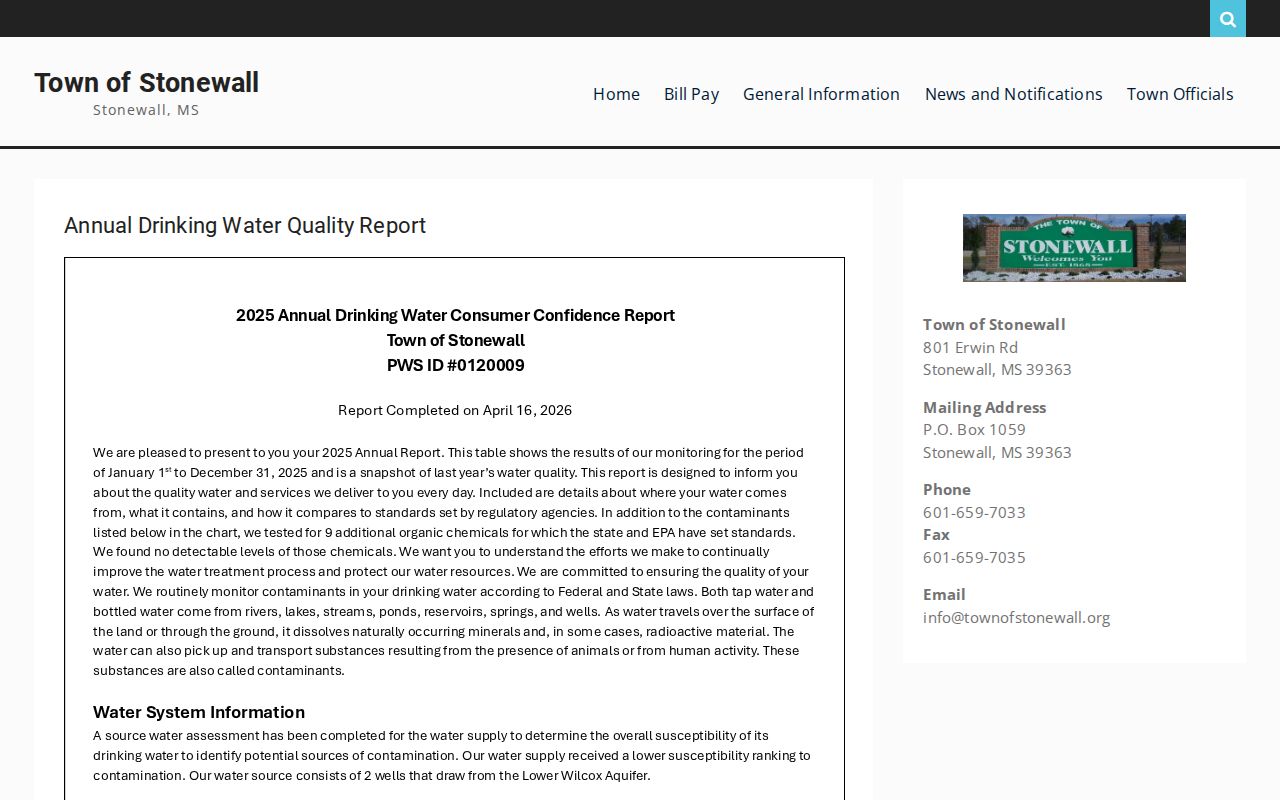
For a current Stonewall record, rely on the clerk, the citation, or the court's own notice. Historical and civic material is not a live case docket.
Stonewall Court Dates and Settings
Stonewall posts no public calendar showing individual municipal case settings. The town's contact page offers no docket-search fields or settings list either. So confirm any appearance date by phone with the court clerk. Use the date on the citation as your starting reference. Follow the court if it says the date moved.
| Date | The specific Stonewall event date on the citation, notice, docket, or later court confirmation. |
|---|---|
| Time | The time supplied by the Stonewall clerk for the docket call or individual setting. |
| Location | The court location given by Stonewall Town Hall, rather than an assumed county courtroom. |
| Court | Stonewall Municipal Court or the separate county court printed on the case papers. |
| Setting type | The event label, such as arraignment, trial, compliance, or another proceeding, that explains why attendance is required. |
If a Stonewall date is continued or reset, ask for the new date and what changed it. A term date, a town event, or an old calendar does not confirm a live case setting.
Stonewall Court Setting Terms
Reading a Stonewall court notice means separating events from outcomes. A setting is just a scheduled event, not a ruling. A filing date shows when the court accepted a document. An appearance date tells a party when the court expects action. The clerk can explain the local schedule. Legal questions belong with a legal adviser.
- Docket sheet
- A chronological list of Stonewall or county case events, filings, orders, and status changes.
- Arraignment
- A criminal proceeding at which the charge and plea process are addressed.
- Continuance or reset
- A moved setting. Confirm the new Stonewall date with the court.
- Disposition
- The recorded outcome, which can be a dismissal, plea, judgment, or other resolution.
Never treat a docket amount as a balance due. For a Stonewall ticket, payment direction must come from the court itself, not an online search result or an informal calculation.
Stonewall Traffic Tickets
Which court holds a Stonewall ticket depends on who wrote it. A Stonewall police officer or ordinance citation lands in Stonewall Municipal Court. A Mississippi Highway Patrol or Clarke County Sheriff citation belongs to Clarke Justice Court. An address in Stonewall alone settles nothing. Hold onto the citation number too. It is the best identifier when the city publishes no local ticket lookup form.
Call the Stonewall clerk before you pay anything. Three questions matter. Does payment close the case? Is a court appearance still required? How do you contest the ticket or ask for a continuance? The Mississippi DPS citation guidance points disputes to the court in the jurisdiction where the ticket was issued. Keep your receipt and the court disposition for your files.
The state also runs a public eCite page. It offers citation abstracts and statistics for participating agencies. Treat it as a research aid. It is not a full Stonewall case docket. It will not show every court outcome.
Stonewall Ticket Court Routing
| Ticket clue | Likely first route | What to verify |
|---|---|---|
| Stonewall city or ordinance citation | Stonewall municipal clerk | Court name, date, payment and contest process |
| MHP or Sheriff citation | Clarke Justice Court | Citation court line and current appearance date |
| DUI or driver-status question | Issuing court plus MDPS procedure | Court disposition and any separate state process |
Stonewall publishes no local payment vendor, deferred-disposition schedule, or fee chart. Ask the responsible court for those details directly. One more caution from county and state sources is in order. The consequences of missing a court date depend on the case and the law. Never stretch a generic warning into a broad conclusion.
Where Stonewall Cases End Up
City matters and county cases move on separate tracks in Stonewall. The county court directory sends MHP and Sheriff traffic to Justice Court. Felony trials and broader civil claims go through Circuit Court. The Circuit Clerk is the records channel there. Chancery Court handles family, estate, guardianship, equity, and land matters. The Chancery Clerk keeps those files. These are distinct courts with separate clerks. They are not just search filters inside one Stonewall court docket.
Docket flow: Stonewall Municipal Court › Clarke County Justice, Circuit, or Chancery Court › Mississippi appellate courts when an appeal is properly taken.
Has a Stonewall case reached Circuit or Chancery Court? MEC access splits by district and requires public registration. For choosing a county-level record route, the Clarke County court docket overview is the broader reference.
Stonewall Court Docket and MEC
Stonewall municipal access and MEC are two different worlds. The city offers no municipal online docket. The Circuit and Chancery courts, though, both take part in Mississippi Electronic Courts. Tenth Circuit CourtInfo gives Clarke's go-live date as August 17, 2020. Twelfth Chancery CourtInfo lists November 1, 2015. CourtInfo is system metadata, not a public Stonewall municipal docket.
Using public MEC means registering. You pick the right court system and search by supported case or party criteria. Expect fees. Registration runs $10 a year, and pages from a search cost $0.20 each. Even a no-match search incurs a one-page charge. Confirm current terms and charges at the official portal before you rely on the service.
One more trap deserves mention. A permission notice may mean a restricted document, not a failed Stonewall search. The courthouse or clerk viewing route stays open during normal hours. It is subject to court rules and copy charges.
Public Access to Stonewall Court Records
Want a Stonewall municipal record? Start with the court clerk. Ask for the public, unsealed file and give the citation or case number. But a simple public-record request does not control court files. The judiciary's access policy, court rules, and confidentiality laws govern what a court can release. Public-body records, where applicable, fall under the separate Mississippi Public Records Act framework.
Key Rules:
Mississippi Code §25-61-5 addresses written public-record access procedures and the separation of exempt material where possible.
Mississippi Code §25-61-7 permits authorized direct costs for searching, reviewing, copying, and transmitting records.
Mississippi Judiciary public-records policy explains the judicial-branch policy layer for court records.
Mississippi Code §§43-21-261 and 93-17-25 contain special confidentiality protections for youth and adoption matters.
Some files stay closed no matter how you ask. Sealed cases, restricted documents, juvenile records, adoption records, and protected identifiers may all be withheld. Stonewall or a county clerk may deny part of a request. If so, ask for the legal basis. Then ask whether an unsealed, nonexempt portion can be released.
Stonewall Court Record Checklist
Gather your details before contacting Stonewall. Write down the citation number, court name, and party name. Match the name to the case file exactly. Note the record you want and whether a certified copy is needed. Ask the clerk where to send a request. Ask whether payment should wait for an estimate, and how a final disposition is documented. A receipt is not the same thing as a certified court record.
For county records outside the Stonewall municipal docket, route by court. The Circuit Clerk holds Circuit civil and criminal files. The Chancery Clerk keeps Chancery and land-related records. The county FAQ gives the routing baseline, and the responsible office supplies current copy instructions. Save your request and response dates in case a follow-up becomes necessary.